10 Best Crisp Alternatives in 2026 (We Tested Them All)
Crisp has a 1.7/5 on Trustpilot. We tested 10 alternatives hands-on with honest takes on pricing, AI, and what each tool actually gets right.
Crisp has a lot going for it on the surface. The pricing looks simple, the widget is clean, and the free plan gets you through the door without a credit card. For a startup with five customers and no real support volume, it works.
But then things start to break.
You need AI that handles more than 50 actions a month. You need SLA tracking. You want to export your conversation data, and you find out you can't. Your account gets suspended out of nowhere because you triggered some undocumented rule. And the plan that was supposed to cost you $45/month? You're now paying $295/month because every feature you actually need sits behind the Plus tier.
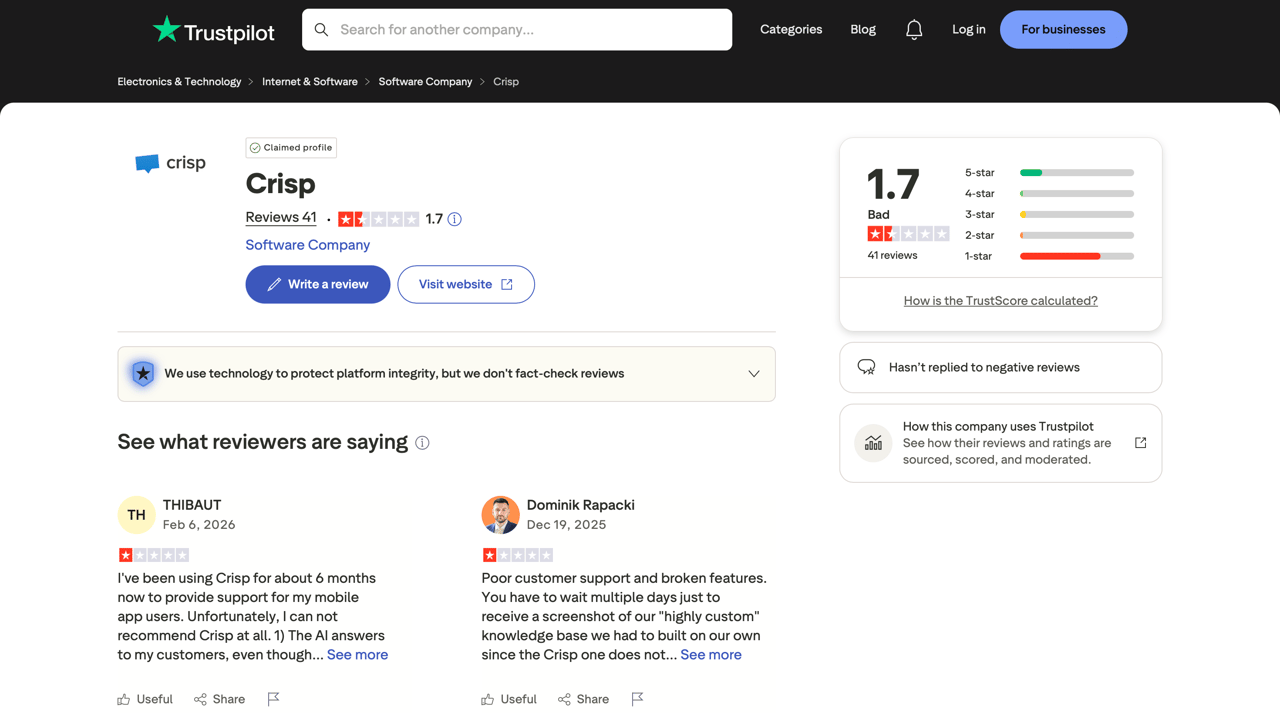
This isn't speculation. Crisp has a 1.7/5 on Trustpilot1. 71% of the reviews are one star. That's not a blip. That's a pattern.
So if you're shopping for something better, here are 10 alternatives we went hands-on with. No fluff, no filler. Just what each tool does well, where it falls short, and what it'll actually cost you.
The quick version:
- SupportWire - Best overall (AI-native, transparent pricing, modern design)
- Intercom - Best for funded startups with complex workflows
- Zendesk - Best for enterprise teams that need the full stack
- Freshdesk - Best budget-friendly Zendesk alternative
- HelpScout - Best for teams that live in email
- LiveChat - Best standalone chat widget
- Tawk.to - Best free option (with caveats)
- Tidio - Best for small ecommerce teams
- HubSpot Service Hub - Best if you already use HubSpot
- Olark - Best minimalist live chat
Why look for a Crisp alternative?
Three problems keep coming up in reviews, forums, and conversations with teams who've switched away from Crisp.
The pricing bait-and-switch
Crisp advertises four plans: Free, Essentials ($45), Plus ($95), and Ultimate ($295). Looks clean. But here's how it plays out in practice: the Free plan is a demo. The Essentials plan caps AI at 50 actions per month and doesn't include SLA management, phone, or white-labeling. The Plus plan gets you most of what you need, but $95/month buys you a workspace, not a team. Multiple brands or products? That's multiple workspaces, each at full price.
90% of teams end up on the $295/month Ultimate plan2. And if you're running WhatsApp, you need Meta credits on top of that. Software fees are just the start - calculate your true fully-loaded support cost to see the full picture.
Account suspensions without warning
This one is wild. Multiple users have reported getting their Crisp accounts suspended with no prior notice and no clear explanation3. One Trustpilot reviewer described losing access to their entire support history overnight4. Crisp's response? Essentially "you violated the terms." No specifics, no appeal process, no data export.
For a tool that holds your customer conversations, that's a dealbreaker.
No data portability
You'd think exporting your support data would be table stakes. With Crisp, you can't export full conversation transcripts. You can pull some data through the API, but a clean CSV export of your chat history? Doesn't exist. That makes leaving Crisp significantly harder than it should be, which might be the point.
The 10 best Crisp alternatives
1. SupportWire
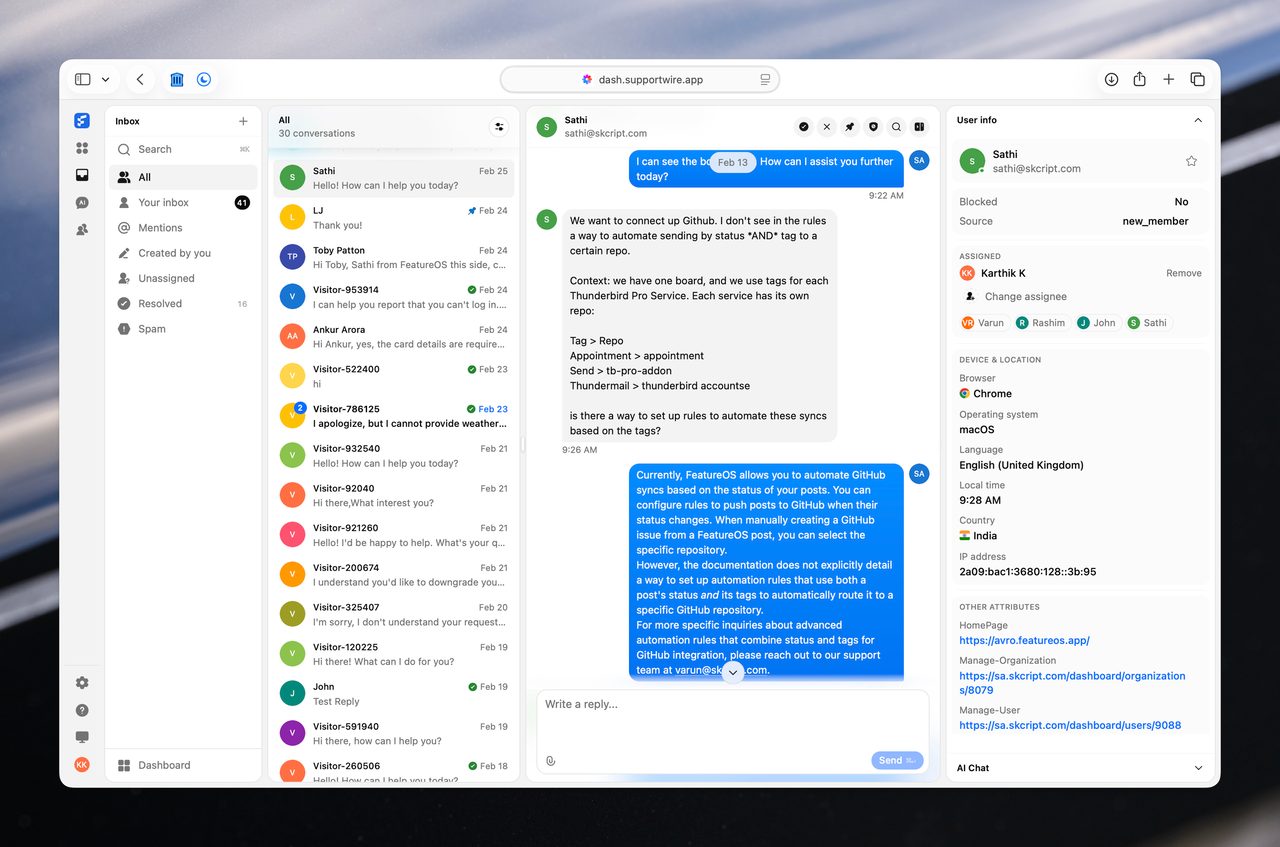
SupportWire is built for support teams that want everything in one place without the pricing gymnastics. Live chat, AI, ticketing, knowledge base, phone support. All included on every plan.
Full disclosure: we built it. But we built it specifically because we kept running into the problems I just described with tools like Crisp. So consider the bias disclosed, and then look at the feature list anyway.
What stands out:
- AI at $0.49 per resolution - exactly half of Intercom Fin's $0.99, and only billed when Kal actually closes the ticket. Drafting and Copilot stay free.
- Phone support built in - not an add-on, not a separate product. Every plan.
- SLA management - set rules, track performance, get alerts. Crisp doesn't offer this at all.
- Modern design - the widget and dashboard are genuinely good-looking. Sounds superficial, but your customers see this thing every day.
- Full data export - your data is yours. Export everything, anytime.
- One-click cancellation - no calling a retention team. No 30-day negotiation.
How it beats Crisp:
SupportWire includes phone support, SLA tracking, and uncapped AI on every plan. Crisp gates all of these behind its highest tier or doesn't offer them at all. The big difference is predictability. You know what you're paying, and you know what you're getting.
Pricing: Per-seat pricing, transparent. No workspace multiplication, no AI credit limits, no surprise invoices. Read our product principles to understand why we build this way.
See the full Crisp vs SupportWire comparison
2. Intercom
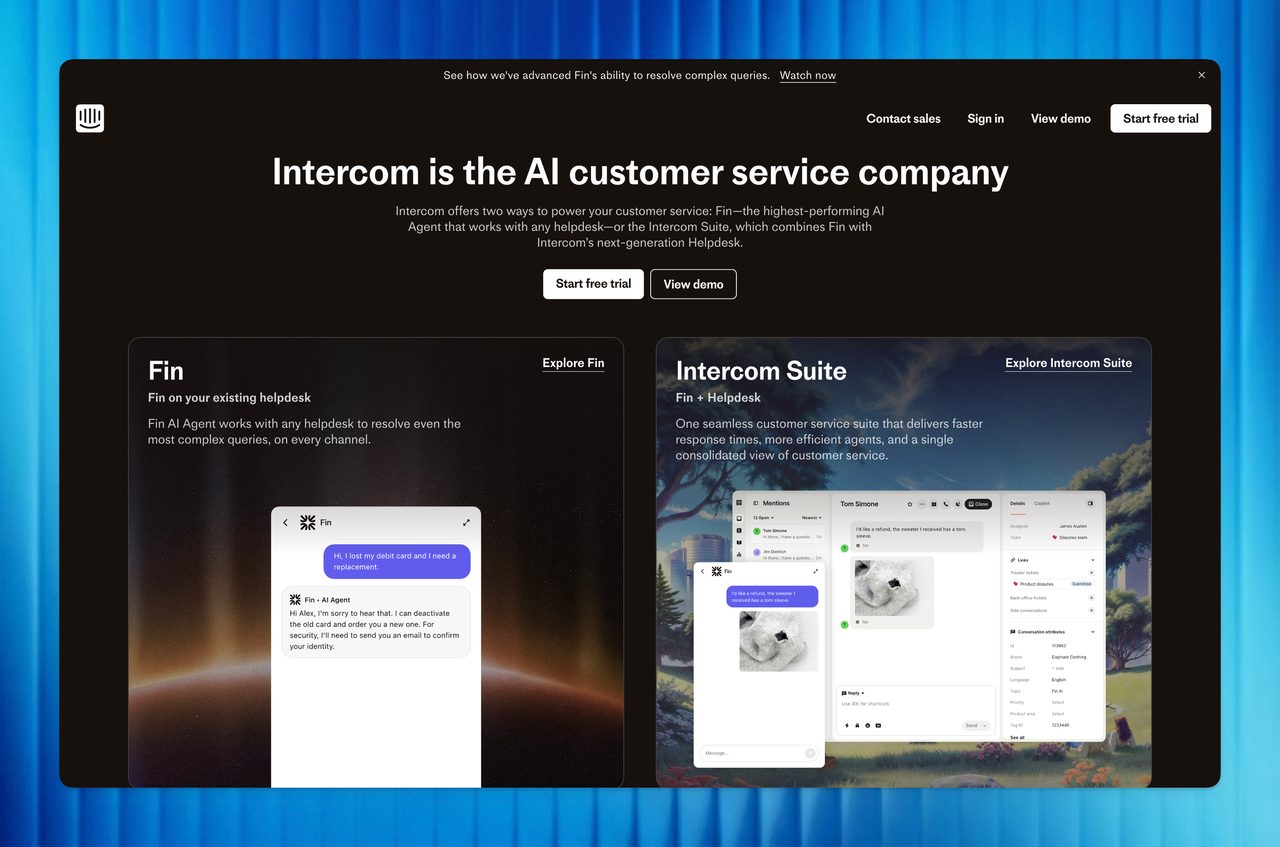
Intercom is the 800-pound gorilla in customer messaging. Their product is genuinely impressive. The messenger feels great, the workflows are powerful, and their Fin AI bot has one of the highest resolution rates in the industry.
The catch? The price.
What stands out:
- Fin AI - resolves around 65% of conversations automatically. It's legit.
- Proactive messaging - target users based on behavior, segment, lifecycle stage. Nobody does this better.
- Product tours - built-in onboarding flows without a separate tool.
- Workflows - visual automation builder that handles complex routing and escalation.
- 300+ integrations - basically connects to everything.
How it beats Crisp:
In almost every dimension. Better AI, better analytics, better automation, better integrations. Crisp is playing a different game entirely. The gap in workflow automation alone is massive.
Where it falls short:
Fin costs $0.99 per resolution on top of your seat fees. Teams that enable it see bills jump 50-120%5. And if you want quality monitoring for those AI resolutions, that's another $99/month for their Pro add-on. Contracts auto-renew at $20K+ without warning6. And their own support team? Slow to respond and hard to reach. The irony isn't lost on anyone.
Pricing: Starts at $29/seat/month (Essential). Fin AI is $0.99/resolution extra. Real-world cost for a 10-person team with AI: $700-1,500/month depending on volume.
Compare Intercom vs SupportWire
3. Zendesk
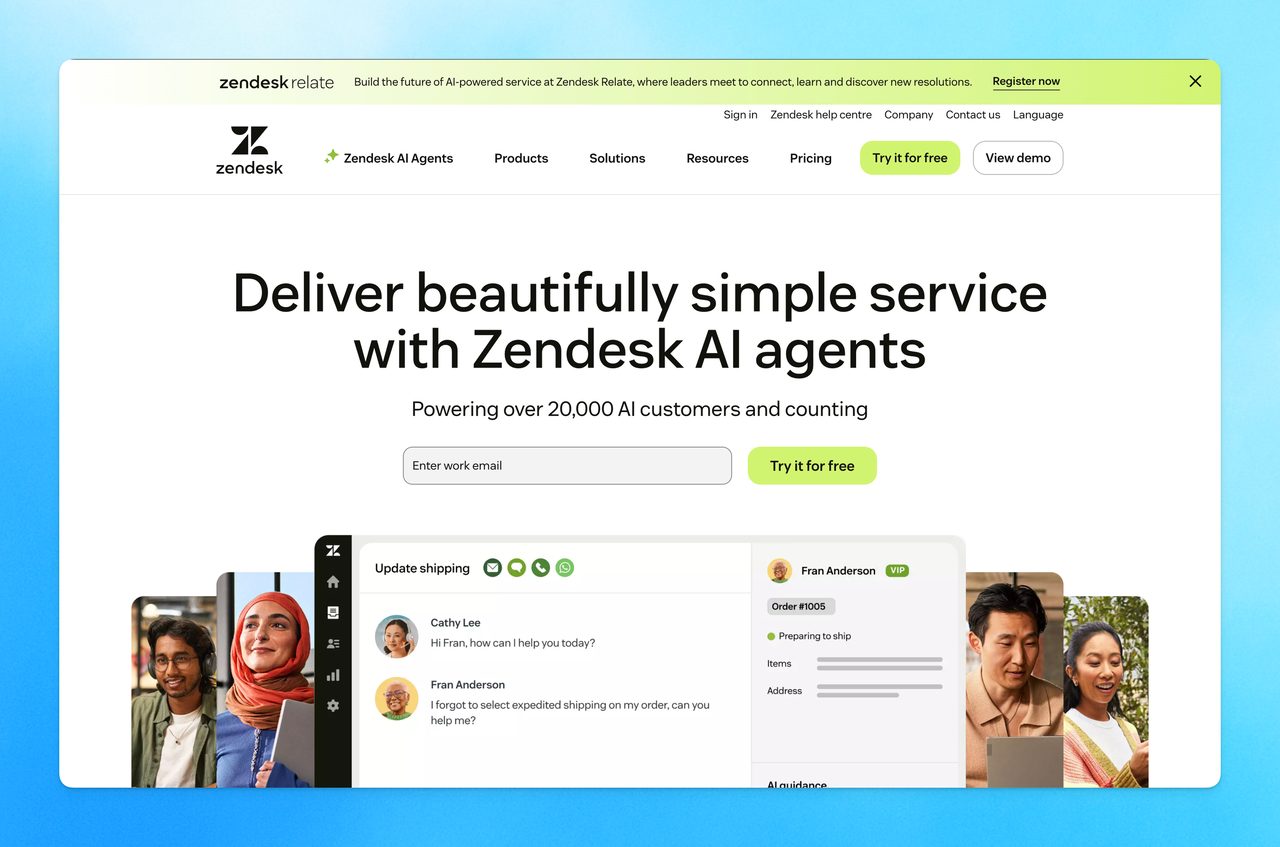
Zendesk has been around since 2007 and powers support for companies like Shopify, Uber, and Slack. If you need enterprise-grade ticketing, SLA enforcement, and compliance certifications, Zendesk has it.
If you need a tool you can set up this week, look elsewhere.
What stands out:
- Ticketing - still best-in-class. Custom fields, views, macros, triggers, automations.
- Omnichannel - email, chat, phone, social, WhatsApp. All in one queue.
- Zendesk Talk - built-in VoIP phone support.
- SOC 2 + HIPAA - compliance-ready for regulated industries.
- 1,900+ integrations - the biggest marketplace of any support tool.
How it beats Crisp:
Crisp doesn't have phone support, SLA management, or any compliance certifications. Zendesk has all three. For teams that need structured ticket workflows rather than casual chat, there's no comparison.
Where it falls short:
Setup takes 4-8 weeks. The pricing page lists seven different SKUs, and most features require add-ons. Their AI add-on costs $50/agent/month plus $1.50 per resolution. And their Trustpilot score is 1.7 out of 57. Sound familiar?
Pricing: Starts at $55/agent/month (Suite Team). Full setup with AI for a 10-person team runs $15,000-25,000/year easily.
Compare Zendesk vs SupportWire
4. Freshdesk
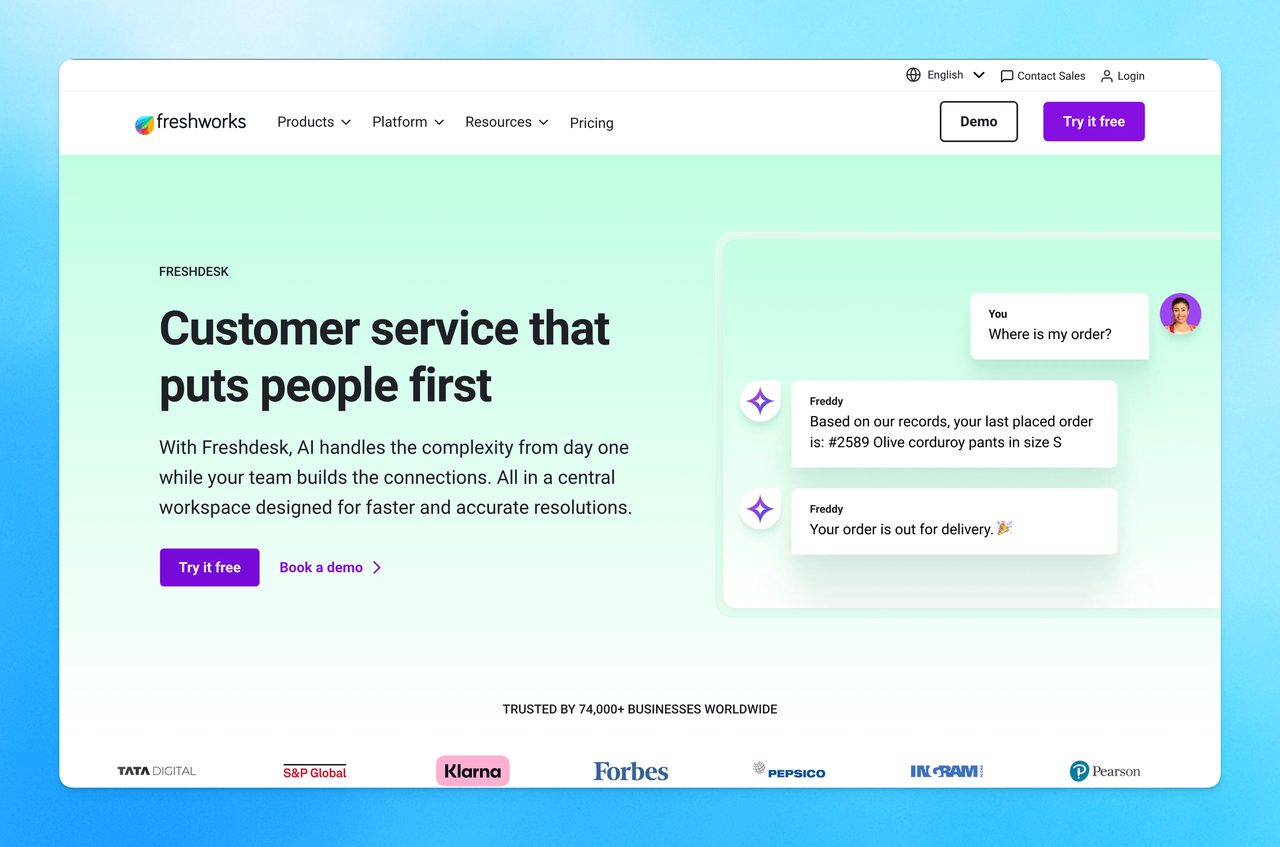
Freshdesk from Freshworks is what Zendesk would look like if someone rebuilt it without the legacy baggage. Similar feature set, friendlier UI, and pricing that doesn't require a spreadsheet to understand.
What stands out:
- Free plan - up to 2 agents with email ticketing, knowledge base, and basic automation. Actually usable, unlike most free tiers.
- Freddy AI - their AI assistant handles ticket summarization, response suggestions, and auto-triage.
- Marketplace - 1,000+ integrations, though quality varies.
- Omnichannel - email, chat, phone, social, and WhatsApp in one view.
- Automations - time-based triggers, event-based rules, and scenario automations.
How it beats Crisp:
Freshdesk gives you proper ticketing with SLA tracking, collision detection, and CSAT surveys. Crisp's ticketing is bare-bones by comparison. The free plan alone offers more functionality than Crisp's Essentials plan.
Where it falls short:
Freshdesk's growth plan ($15/agent/month) is where most teams land, and it's solid. But the interface is starting to show its age. Some workflows feel clunky, and the mobile app gets consistent complaints. Also, Freshworks has a habit of pushing you toward their other products (Freshsales, Freshservice) which muddies the experience.
Pricing: Free for 2 agents. Growth plan at $15/agent/month. Pro at $49/agent/month. Enterprise at $79/agent/month. AI is included at higher tiers.
5. Help Scout
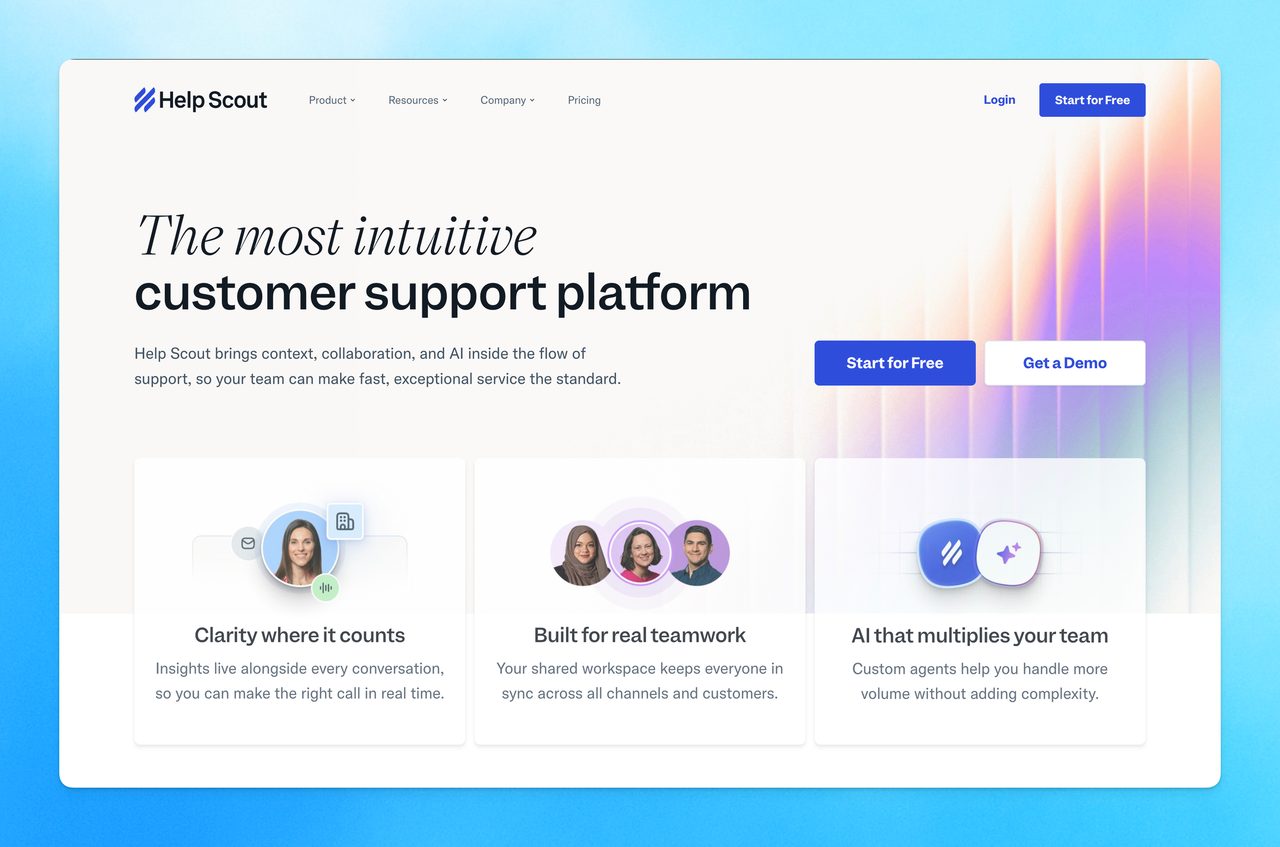
Help Scout is the quiet, steady option. No flashy AI announcements, no growth-at-all-costs energy. Just a clean shared inbox with a good knowledge base and a chat widget called Beacon.
Teams that prefer email-based support tend to love it.
What stands out:
- Shared inbox - clean, fast, does exactly what you'd expect. Collision detection, saved replies, internal notes.
- Docs - their knowledge base is well-designed and SEO-friendly.
- Beacon - embedded widget that surfaces help articles before opening a chat.
- Customer profiles - previous conversations, app activity, and custom properties in the sidebar.
- Satisfaction ratings - built into every conversation.
How it beats Crisp:
Help Scout's shared inbox is a real ticketing system. Conversations have assignments, statuses, tags, and workflows. Crisp tries to do everything through chat, which gets messy when you're handling 200+ conversations a day across multiple channels.
Where it falls short:
Help Scout switched to contact-based pricing in 2024. Teams paying $1,500/year woke up to $7,500 invoices8. No phone support after 14 years. Their AI (Beacon AI) charges $0.75 per resolution on top of your plan. And the chat widget is reactive only. No proactive messaging, no targeting, no in-app tours.
Pricing: Free for up to 50 contacts/month. Standard at $25/user/month. Plus at $75/user/month. Pricing is contact-based, which can scale unpredictably.
Compare HelpScout vs SupportWire
6. LiveChat
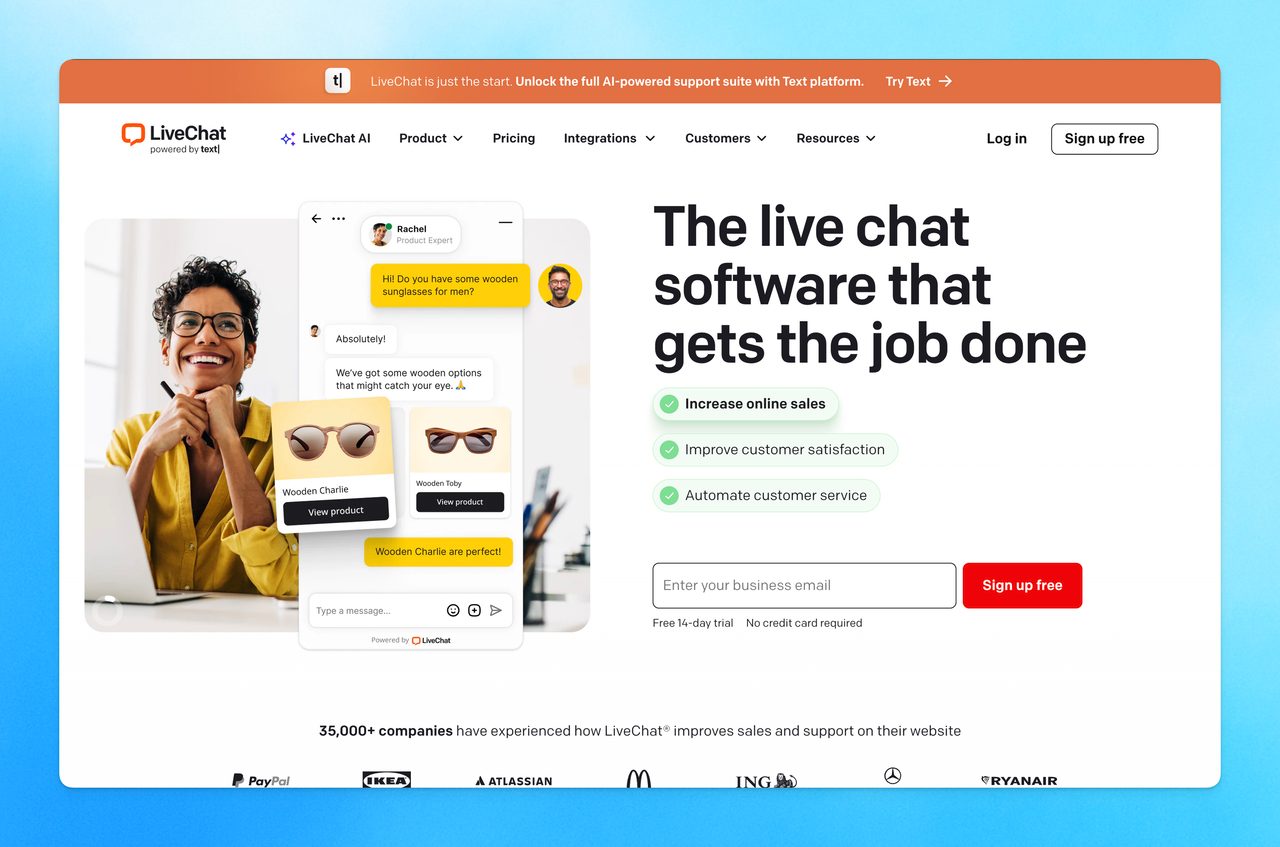
LiveChat is exactly what the name says. A live chat tool. It's good at that one thing, but the problem is that modern support needs more than one thing.
What stands out:
- Chat experience - fast, reliable, well-designed. The core product works.
- Sneak peek - see what visitors are typing before they send it. Surprisingly useful.
- Rich messages - cards, carousels, buttons inside the chat. Makes product recommendations and troubleshooting visual.
- Traffic monitoring - see who's on your site and where they came from.
- Chat surveys - pre-chat, post-chat, and in-chat surveys built in.
How it beats Crisp:
The actual chat experience is more polished. Message delivery is more reliable (Crisp has reported issues with messages not arriving), and the real-time visitor monitoring is more detailed.
Where it falls short:
LiveChat split their product into four separate subscriptions. Chat is one product. Chatbot is another ($52/month). Ticketing is a third ($29/month). Knowledge base is a fourth ($49/month). Want all four? That's $180/month before you've added a single agent seat.
Their Starter plan limits you to one agent and 60 days of chat history. After that, your conversations disappear.
Pricing: Starter at $20/agent/month (1 agent, 60-day history). Team at $41/agent/month. Business at $59/agent/month. Add ChatBot, HelpDesk, and KnowledgeBase separately.
Compare LiveChat vs SupportWire
7. Tawk.to
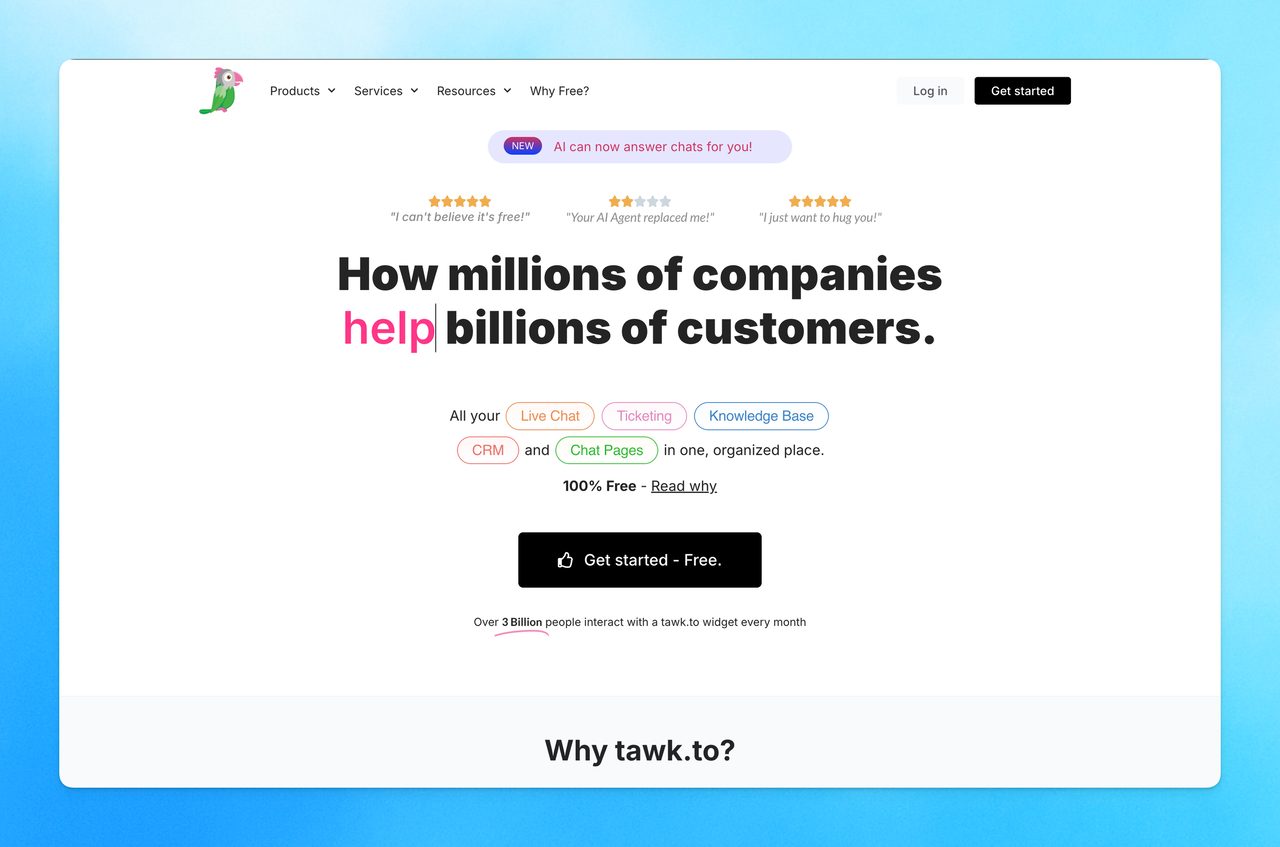
Tawk.to is the free option that everyone tries at some point. And for a zero-dollar tool, it's surprisingly complete. Chat, ticketing, a knowledge base, screen sharing, and analytics. All free.
There's a reason it's free, though.
What stands out:
- Price - zero dollars for unlimited agents. That's real.
- Feature breadth - chat, tickets, KB, video + screen sharing, CRM. All free.
- 2 billion+ chats served - the scale is impressive.
- Multi-language - 45+ languages supported out of the box.
- Hiring agents - they'll staff your chat for $1/hour. Unique model.
How it beats Crisp:
On price, obviously. But also on breadth. Tawk.to's free plan includes features that Crisp locks behind the $295/month tier. Screen sharing, for example.
Where it falls short:
The widget weighs 700KB and measurably impacts your Core Web Vitals9. The design looks like 2016. "Powered by Tawk.to" is stamped on everything (removing it costs $19/month). Automation stops working when agents log off. And there's no real AI to speak of. Their AI add-on starts at $29/month and goes up to $399/month, at which point "free" starts to feel like a loaded word.
Multiple users report being charged after cancellation10. The Trustpilot score is 2.5/511.
Pricing: Free core. Remove branding: $19/month. AI Assist: $29-$399/month. Hired agents: $1/hour.
Compare Tawk.to vs SupportWire
8. Tidio
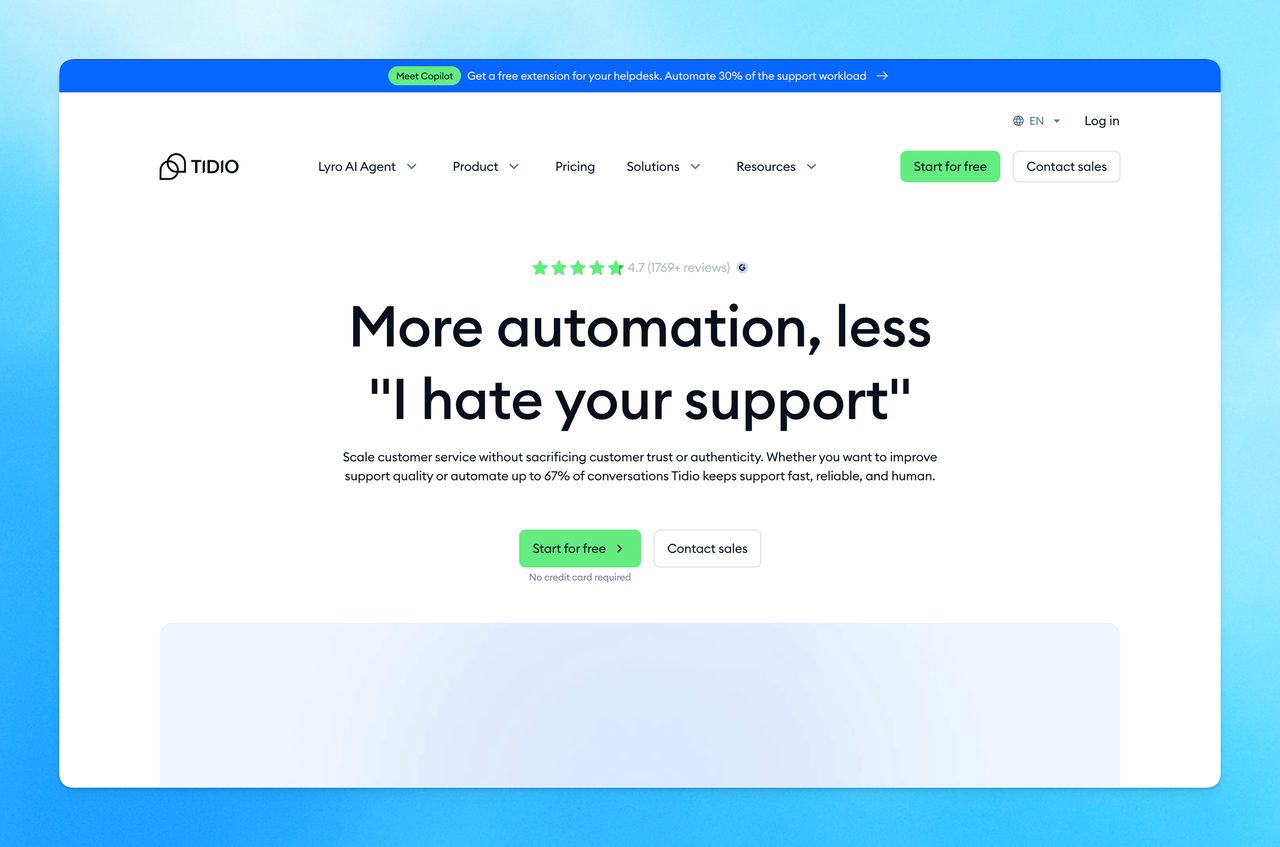
Tidio is built for small businesses and ecommerce shops. If you're running Shopify or WooCommerce and need a chat widget with some AI, Tidio gets you there fast.
What stands out:
- Lyro AI - their AI chatbot is trained on your FAQ content and provides grounded, source-cited responses. Better than most competitors in this price range.
- Ecommerce integrations - Shopify, WooCommerce, BigCommerce. Pulls in order data, product info, and customer history.
- Visual chatbot builder - drag-and-drop flow builder for automated conversations.
- Live visitors list - see who's browsing and what they're looking at.
- Multichannel - email, Messenger, Instagram, and WhatsApp from one inbox.
How it beats Crisp:
Tidio's ecommerce integrations are significantly deeper. An agent can see a customer's order status, cart contents, and browsing history directly in the chat. Crisp's integrations exist but are nowhere near as tight for online stores.
Where it falls short:
Tidio's free plan limits you to 50 live chat conversations per month. Lyro AI gets 50 free conversations, then it's $0.50 each. The design is functional but not particularly memorable. And once you outgrow the small-business use case, Tidio starts to feel limiting. No SLA management, basic reporting, and the analytics aren't deep enough for teams running 500+ conversations daily.
Pricing: Free with limits. Starter at $29/month. Growth from $59/month. Tidio+ from $749/month. Lyro AI conversations are metered.
9. HubSpot Service Hub
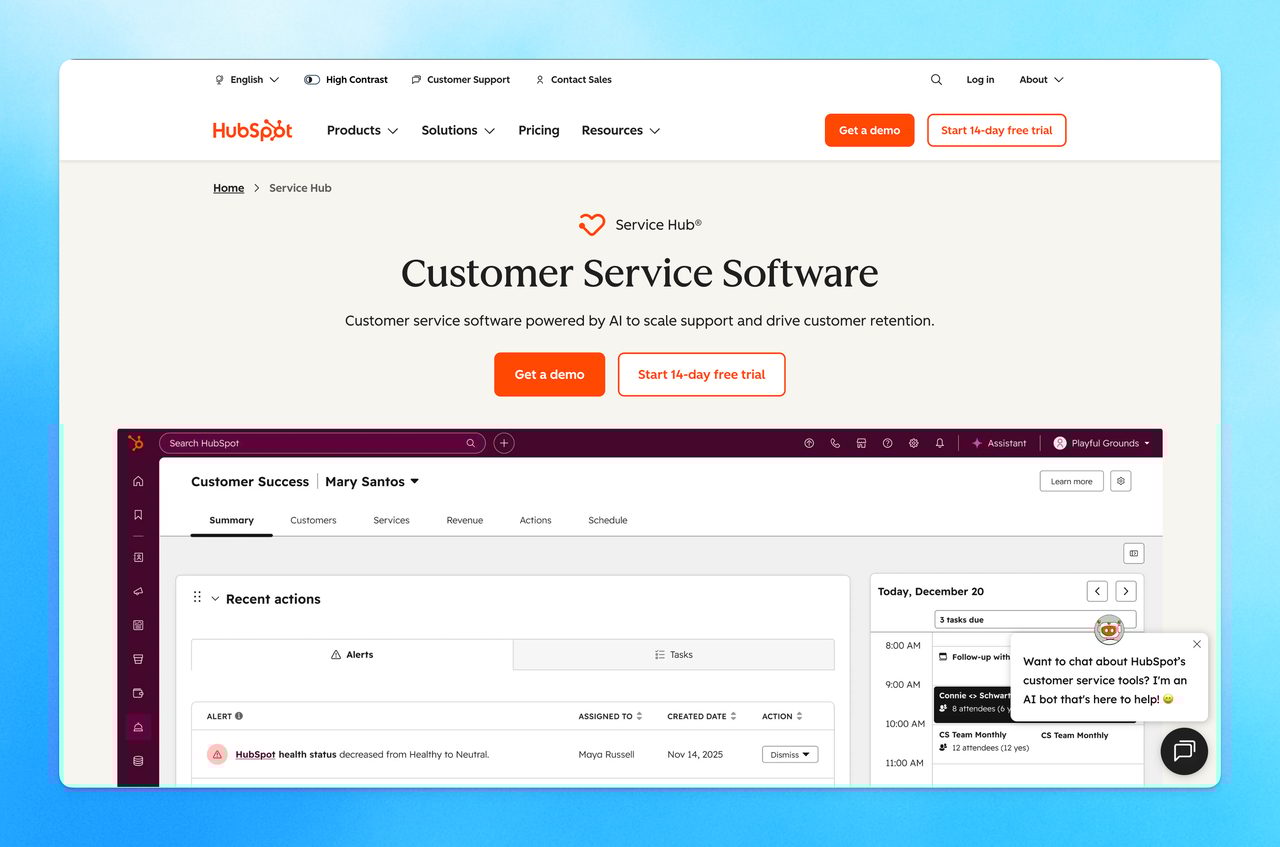
HubSpot Service Hub makes a lot of sense if you're already running HubSpot for CRM and marketing. The data all lives in one place. Customer conversations, deals, marketing interactions, support tickets. One record per contact, everything connected.
If you're not on HubSpot, this probably isn't where you start.
What stands out:
- CRM integration - every support conversation is tied to the full customer record. Sales can see support history, support can see deal stage. Genuinely useful.
- Customer portal - branded portal where customers track their own tickets.
- Feedback surveys - NPS, CSAT, and CES surveys built in with reporting.
- Playbooks - scripted conversation guides for common scenarios.
- Breeze AI - their new AI layer handles summarization, response drafting, and ticket routing.
How it beats Crisp:
The CRM connection is the killer feature. Crisp has integrations with CRMs, but it's never as tight as having support natively inside the CRM. If your sales team needs to know about support issues before a renewal call, HubSpot makes that effortless.
Where it falls short:
The free tools are genuinely limited. To get anything useful for support, you need the Starter plan at $20/month per seat, and even that's basic. Professional runs $100/seat/month. The interface is getting bloated. HubSpot keeps adding features across all hubs, and navigation has become a maze. Setup isn't trivial either.
And if you ever want to leave HubSpot... good luck. Lock-in is real.
Pricing: Free tools available. Starter at $20/seat/month. Professional at $100/seat/month. Enterprise at $150/seat/month.
10. Olark
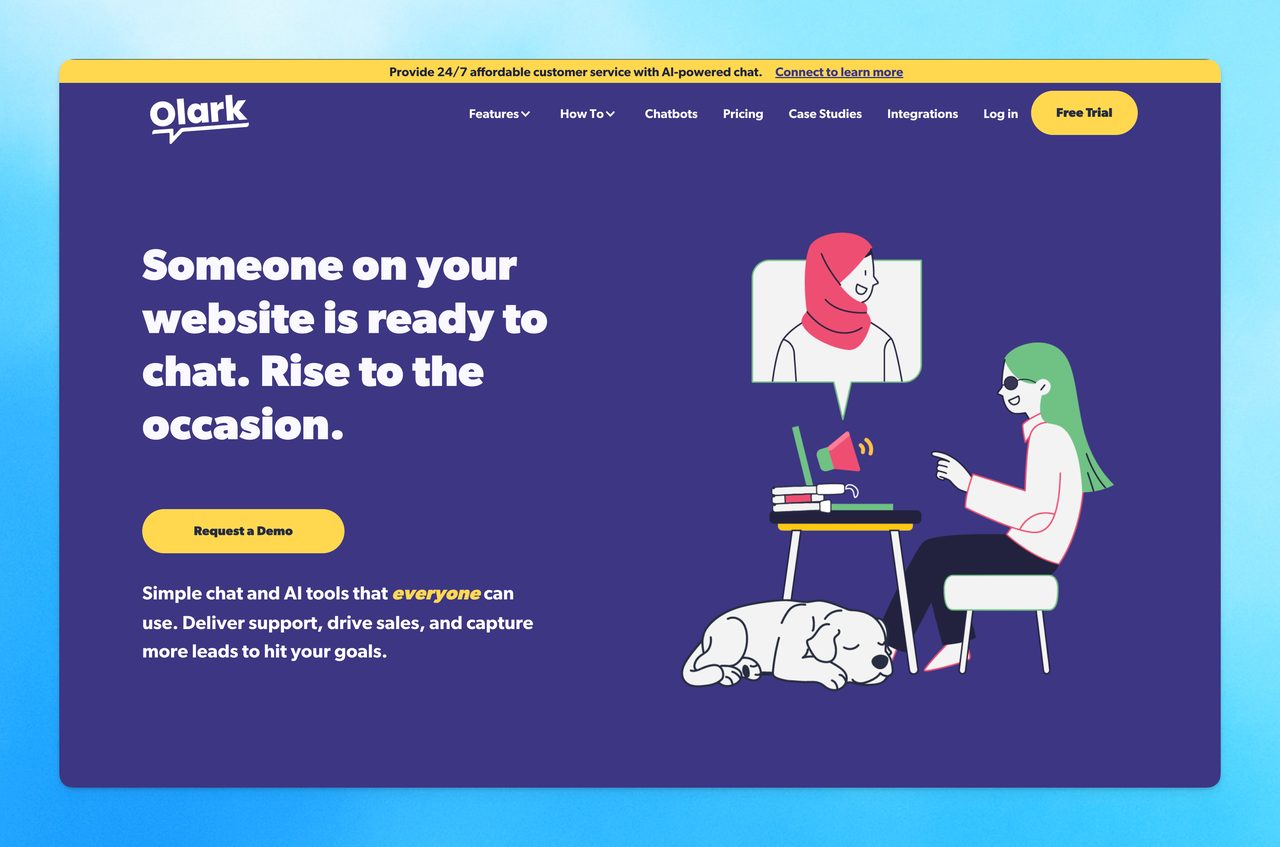
Olark is for teams that want live chat and nothing else. No AI hype, no bundled ticketing, no knowledge base builder. Just a chat widget that works.
There's something refreshing about that.
What stands out:
- Simple setup - paste a script tag, customize colors, you're live in 10 minutes.
- PowerUps - modular add-ons for specific needs. Co-browsing ($99/month), visitor insights ($59/month), non-branded chat ($59/month).
- Accessibility - WCAG 2.0 AA compliant out of the box. One of the few chat tools that takes this seriously.
- Targeted chat - rules-based triggers to start conversations based on behavior.
- Transcripts - searchable, exportable, automatically emailed after each chat.
How it beats Crisp:
Olark is transparent about what it is and what it isn't. No bait-and-switch pricing, no feature gates designed to push you to a higher tier. You pick the plan, add the PowerUps you need, and that's your bill. After Crisp's pricing games, that kind of honesty is underrated.
Where it falls short:
No AI chatbot. No ticketing. No knowledge base. No phone support. If you need any of those things, Olark isn't your tool. It's also a small company, which means slower feature development and a smaller integration ecosystem. The design is clean but hasn't evolved much in the last few years.
Pricing: Standard at $29/seat/month. PowerUps range from $29-$99/month each.
So which one should you pick?
Depends on what broke for you with Crisp.
If pricing unpredictability is the issue: SupportWire. Honest per-seat pricing (Free / $39 / $79), AI at $0.49 per resolution (half of Fin), no credit budgets or workspace multiplication.
If you need enterprise features: Zendesk. It's expensive and slow to set up, but it's the most complete platform on this list.
If you want the best AI: Intercom's Fin is hard to beat on resolution rate. Just budget for the per-resolution fees.
If you're email-first: Help Scout. The shared inbox is clean and fast.
If you need it free: Tawk.to. Accept the tradeoffs (design, performance, branding) and it works.
If you're in ecommerce: Tidio. The Shopify and WooCommerce integrations are the deepest here.
If you're already on HubSpot: Service Hub. The CRM connection is worth the switching cost.
For most teams leaving Crisp, the real frustration is that they signed up for simple, affordable support and got something that's neither simple nor affordable once you actually need it to work. Whatever you switch to, make sure you understand the real cost at your volume, not just the number on the pricing page.
We built SupportWire because we wanted a tool where the pricing page tells the truth. If that resonates, give it a look.
Want to see how other tools stack up? Check out our full comparison page or the individual breakdowns: Intercom vs SupportWire, Zendesk vs SupportWire, HelpScout vs SupportWire.
Footnotes
-
Crisp Trustpilot reviews, 1.7/5 from 41 reviews as of March 2026. trustpilot.com/review/crisp.chat ↩
-
Based on Crisp pricing page analysis. The Essentials plan ($45/mo) lacks SLA management, phone, white-labeling, and caps AI at 50 actions. crisp.chat/en/pricing ↩
-
Trustpilot review describing account suspension without notice. trustpilot.com/review/crisp.chat ↩
-
Trustpilot review, user reported complete loss of support history after suspension. trustpilot.com/review/crisp.chat ↩
-
Reddit r/SaaS, user reported 120% billing increase after enabling Intercom's Fin AI. reddit.com/r/SaaS ↩
-
Intercom Trustpilot reviews, multiple reports of $20K+ auto-renewals without notice. trustpilot.com/review/intercom.io ↩
-
Zendesk Trustpilot reviews, 1.7/5 from 692 reviews as of March 2026. trustpilot.com/review/zendesk.com ↩
-
Multiple Help Scout users on Capterra and G2 reported 3-5x price increases after the 2024 contact-based pricing switch. capterra.com/reviews/help-scout ↩
-
Tawk.to widget payload measured at approximately 700KB via Chrome DevTools network tab. Impact on Lighthouse performance scores documented via PageSpeed Insights. ↩
-
Tawk.to Trustpilot reviews, users reporting charges after cancellation. trustpilot.com/review/tawk.to ↩
-
Tawk.to Trustpilot reviews, 2.5/5 from 102 reviews as of March 2026. trustpilot.com/review/tawk.to ↩
Frequently asked questions
It depends on what broke for you. If pricing unpredictability is the issue, SupportWire keeps it honest: Free, $39, or $79 per month, with AI at $0.49 per resolution. If you need enterprise features, Zendesk is the most complete platform. If you want the strongest AI resolution rate, Intercom's Fin leads, at $0.99 per resolution. If it has to be free, Tawk.to works once you accept the tradeoffs.
Three patterns come up again and again. Plans that look like $45/month land near $295/month once the features you need turn out to live on the Plus tier. Accounts get suspended without warning over undocumented rules. And there is no clean export of your conversation history. As of March 2026, Crisp holds a 1.7/5 on Trustpilot, and 71% of those reviews are one star.
Not fully. Crisp has no self-serve export of complete conversation transcripts. Some data is reachable through the API, which is how migration tools pull your history out, but a clean CSV of your chat history does not exist. SupportWire's importer uses that API path to bring over conversations, contacts, and saved replies automatically.
Most Crisp teams are live the same day. Conversations, contacts, team setup, and saved replies import automatically, and Continuity keeps open threads alive across the cutover, so customers can reply to old messages and you pick them up in SupportWire. See the migration playbook for the full steps.
Updated June 2026


